What actions should we take when national and European regulations overlap?
1 December 2025
Influencer marketing: which legislation regulates this now unavoidable commercial practice?
18 March 2026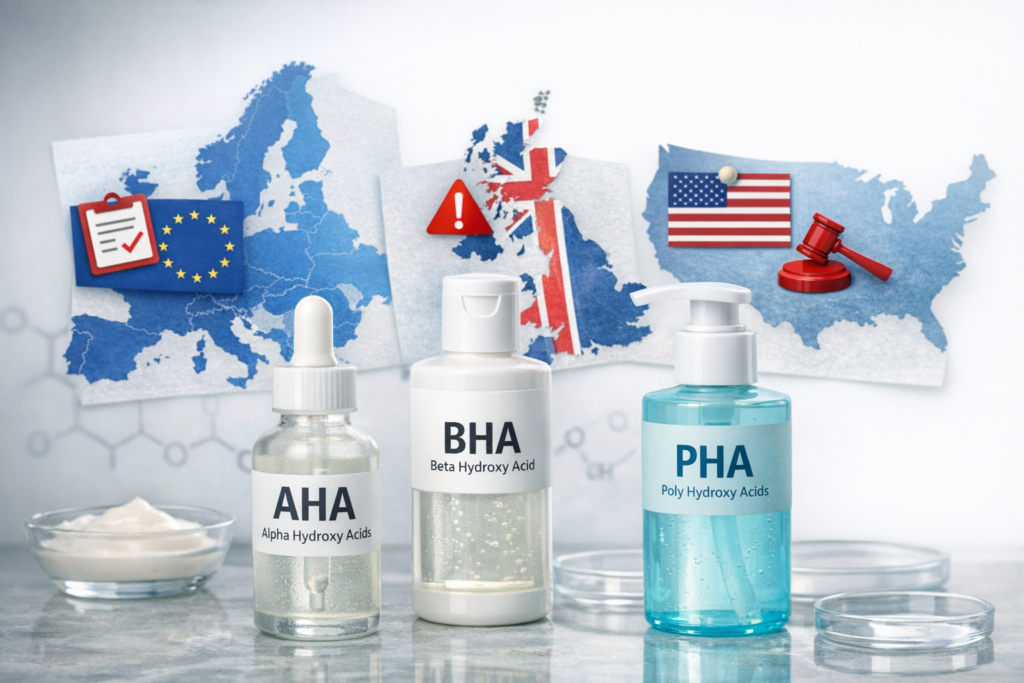
Hydroxy acids, including AHAs, BHAs, and PHAs, are exfoliating agents that have been widely used in cosmetic formulations for several decades to improve skin texture and radiance. Their well-established efficacy goes hand in hand with sensitivity safety considerations (irritation, photosensitisation) and regulatory approaches that vary by region.
This article reviews the regulatory frameworks in the European Union, the United Kingdom, and the United States, with the aim of providing a clearer understanding of these issues.
What’s behind these acronyms?
AHAs are the most common. The term refers to Alpha-Hydroxy Acids and includes, in particular, glycolic acid and lactic acid. They are water-soluble and therefore act primarily on the skin’s surface, where they exfoliate the outermost layer of the epidermis and promote cell renewal.
Within the BHA (Beta Hydroxy Acids) family, the principal compound is salicylic acid. These are lipid-soluble and can penetrate the skin’s pores, which contributes to their exfoliating, comedolytic, and “anti-inflammatory” properties.
Finally, PHAs (Polyhydroxy Acids) include gluconic acid, gluconolactone, and lactobionic acid. They act as humectants by binding water in the epidermis, thereby enhancing hydration. They also provide similar effects to those of AHAs.
What the texts say….
AHA
In the European Union
For the use of AHAs in the EU, it is necessary to go beyond Regulation (EC) No 1223/2009 on cosmetic products and rely on the opinions issued by the independent expert committee, the SCCS (Scientific Committee on Consumer Safety), to determine permitted levels of use and conditions of use (pH, concentration, sensitive populations).
Only the two most common ones have been subject to an evaluation (published in 2000 and confirmed in 2004), which concludes that:
- Glycolic acid may be used safely at a maximum concentration of 4% and at a pH ≥ 3.8
- Lactic acid may be used safely at a maximum concentration of 2.5% and at a pH ≥ 5.0.
It is also recommended to:
- avoid exposure to the sun,
- use adequate sun protection,
- avoid contact with the eyes.
In the United Kingdom
Nothing has been published about this class of ingredients since Brexit (2020).
In the absence of an official UK position on the subject, it is generally assumed that British toxicologists continue to cite the SCCS advice as a scientific benchmark.
In the United States
Particular caution is required with respect to claims associated with products containing AHAs : for example, skin-lightening products are classified as OTC (Over The Counter) drugs.
The FDA has issued guidance stating that over-the-counter cosmetic products may contain up to 10% glycolic and lactic acids and have a pH ≥ 3.5.
They must also be formulated with an SPF (Sun Protection Factor), and the label must bear a clear statement recommending the use of appropriate sun protection (“Sunburn Alert”).
Furthermore, in the states of New York and California, bills to prohibit the sale of certain products containing these ingredients to individuals under 18 were introduced in 2025.
BHA (Salicylic acid)
In the European Union
Salicylic acid is regulated under Annex III (entry 98) and Annex V (entry 3) of Regulation (EC) No 1223/2009.
The SCCS was recently mandated (January 2026) to assess its overall exposure.
In the United Kingdom
Following its evaluation by the SAG-CS in January 2022, the UK authorities added this substance to Annex III (entry 98) and restricted its use in cosmetic products (not as a preservative).
In the United States
Salicylic acid is considered an active ingredient in anti-acne and anti-dandruff products, which are classified as both OTC drugs rather than cosmetics. Therefore, as with AHAs, particular attention must be paid to the product’s claims if the intention is to remain within the cosmetics category.
Salicylic acid was re-evaluated by the CIR in 2025, which concluded that products containing this ingredient are safe under the customary conditions and concentrations of use; the risk of photosensitisation was dismissed, and the associated recommendations are therefore no longer deemed necessary.
PHA
PHAs are not listed as prohibited or restricted products by Europe, the United Kingdom, or the United States. Their use must be deemed safe within the framework of the product’s overall safety assessment.
Key points to bear in mind when developing an exfoliating product containing one of these ingredients
- Comply with the concentrations and pH values recommended by scientific advice or imposed by applicable regulations
- Conduct a comprehensive toxicological assessment and test the tolerance of the finished product when in use
- Include any necessary precautions for use (SPF use, photosensitisation, etc.)
- Check that your product is not classified as an OTC drug in the USA
CLEAR can support you throughout the development of your cosmetics. Do not hesitate to contact us!
Sources :
Egli C, Min M, Afzal N, Sivamani RK. The hydroxy acids: where have we been and what’s new? Dermatol Rev. 2023; 4: 260-267. doi:10.1002/der2.217
Almeman AA. Evaluating the Efficacy and Safety of Alpha-Hydroxy Acids in Dermatological Practice: A Comprehensive Clinical and Legal Review. Clin Cosmet Investig Dermatol. 2024 Jul 16;17:1661-1685. doi: 10.2147/CCID.S453243
https://ec.europa.eu/health/ph_risk/committees/sccp/documents/out121_en.pdf
https://ec.europa.eu/health/ph_risk/committees/sccp/documents/out284_en.pdf
https://www.fda.gov/cosmetics/cosmetic-ingredients/alpha-hydroxy-acids
https://www.cir-safety.org/sites/default/files/ahas.pdf
https://www.fda.gov/cosmetics/cosmetic-ingredients/beta-hydroxy-acids
https://cir-reports.cir-safety.org/view-attachment/?id=f8f3e083-2ca8-b5b4-b338-aa3ca6da8825