
European Regulations That Also Impact the Cosmetics Industry
19 June 2026
Throughout the life cycle of a cosmetic product, various institutional stakeholders are involved. From those who regulate and provide scientific advice to those who carry out inspections, who are they and what role do they play? This article looks at the main stakeholders in the cosmetics sector in Europe and Great Britain, and outlines their respective roles.
In Europe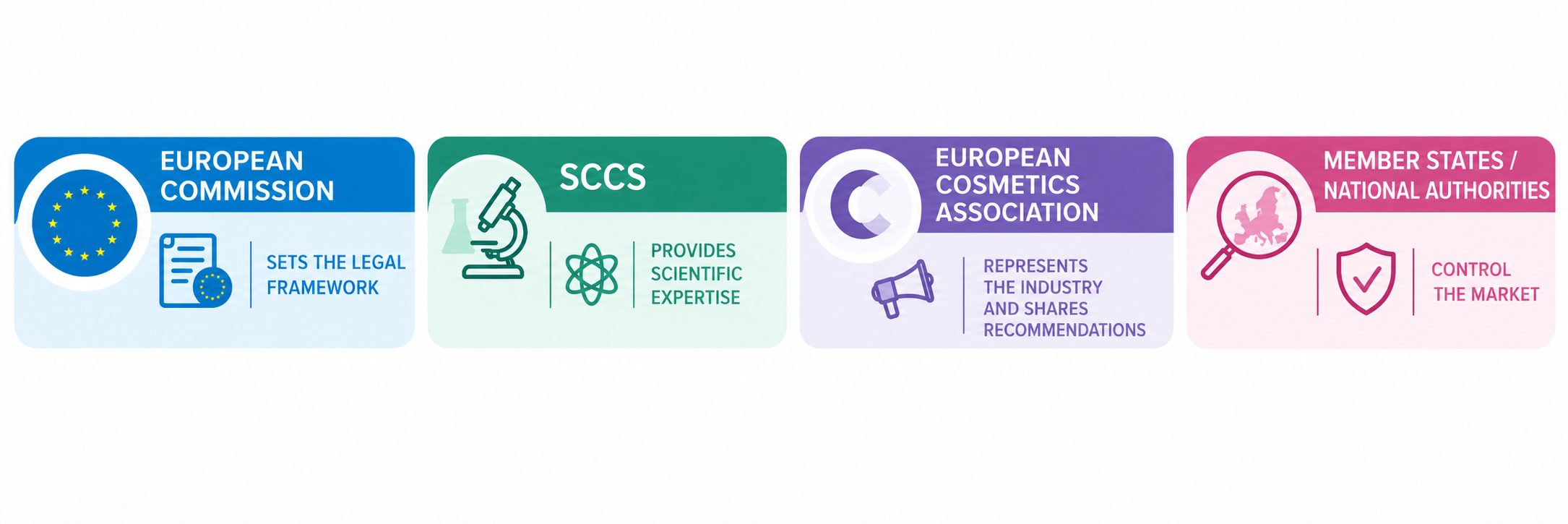
The European Commission
The European Commission plays a central role in the development of the regulatory framework applicable to cosmetic products. In particular, it contributes to the adaptation of Regulation (EC) No 1223/2009 in line with scientific, technical and health developments.
It also plays a role in the implementation of this framework at European level. In particular, it manages the Cosmetic Products Notification Portal (CPNP), the electronic portal through which cosmetic products must be notified before being placed on the market in the European Union. The Commission also works with Member States to promote a harmonised application of the legislation.
It also provides resources for professionals and authorities, including the CosIng database, which provides information on substances and ingredients used in cosmetic products.
The SCCS
The Scientific Committee on Consumer Safety (SCCS) is an independent scientific committee that provides the European Commission with expertise on safety issues relating to non-food consumer products.
In the cosmetics sector, it assesses the safety of certain substances at the Commission’s request. As its role is advisory, it does not directly decide whether an ingredient should be prohibited or restricted. However, its scientific opinions may contribute to the development of the regulatory framework.
Cosmetics Europe
Formerly known as COLIPA, Cosmetics Europe is the trade association representing the European cosmetics industry. It brings together companies from the sector as well as national trade associations.
It represents the interests of the industry before European institutions and also publishes positions, recommendations and guidance documents on various regulatory issues, such as nanomaterials and microplastics.
National authorities
Although the regulatory framework is harmonised at European level, its enforcement is primarily carried out at national level. Each Member State therefore has competent authorities responsible for ensuring compliance with the legislation.
Depending on the country, several authorities may be involved, particularly in market surveillance, risk assessment or cosmetovigilance.
In France
The DGCCRF
The Direction générale de la concurrence, de la consommation et de la répression des fraudes (DGCCRF) is the French administration responsible, among other things, for consumer protection, compliance with the rules applicable to businesses and fair commercial practices.
In the cosmetics sector, it is responsible for the surveillance and control of cosmetic products and establishments. It also handles notifications relating to manufacturing and packaging establishments.
Anses
The Agence nationale de sécurité sanitaire de l’alimentation, de l’environnement et du travail (Anses) is notably responsible for cosmetovigilance and for assessing risks associated with cosmetic products.
ANSM
The Agence nationale de sécurité du médicament et des produits de santé (ANSM) is notably responsible for verifying compliance with Good Laboratory Practice (GLP) requirements for non-clinical studies, as well as granting authorisations for clinical trials involving cosmetic products.
In Great Britain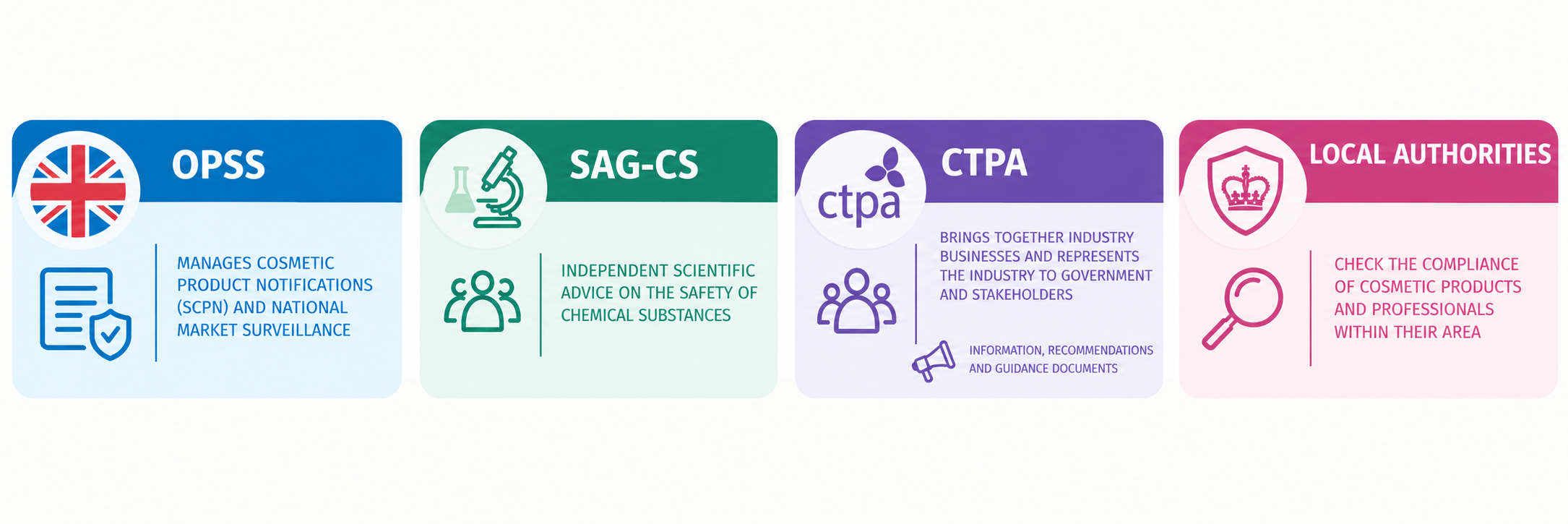 OPSS
OPSS
The Office for Product Safety and Standards (OPSS) plays a central role in enforcing cosmetic product regulations in Great Britain. In particular, it manages the cosmetic product notification system, the Submit Cosmetic Product Notifications (SCPN) service, and carries out market surveillance activities at national level.
SAG-CS
The Scientific Advisory Group on Chemical Safety in Consumer Products (SAG-CS) is a group of scientific experts that provides independent advice on the safety of chemicals present in a range of consumer products.
In the cosmetics sector, its role can be compared to that of the SCCS at European level.
CTPA
The Cosmetic, Toiletry and Perfumery Association (CTPA) brings together companies operating at different levels of the cosmetics supply chain, including manufacturers, brands, distributors, ingredient suppliers and service providers.
It is a key industry stakeholder for the UK cosmetics sector and contributes to dialogue with the government and other stakeholders on developments affecting the sector. It also provides its members with information, recommendations and guidance documents, particularly on regulatory and scientific issues.
Local authorities
The enforcement of the regulations also relies on local authorities, particularly Trading Standards services in England, Scotland and Wales. They are involved in checking the compliance of cosmetic products and businesses within their respective areas.
Complementary roles
These different stakeholders operate at different levels and have distinct responsibilities. Some contribute to the development of the regulatory framework, while others provide scientific expertise. National and local authorities, meanwhile, are primarily responsible for ensuring that the regulations are properly applied through the surveillance and control of products placed on the market.
However, these stakeholders represent only part of the organisations that may be involved in the regulatory framework for cosmetic products. Other organisations may also be concerned, depending on the nature of the products, substances or issues involved…
CLEAR is here to support you throughout the life cycle of your product. Contact us to find out more.
Sources
European Commission – Scientific Committee on Consumer Safety (SCCS): https://health.ec.europa.eu/scientific-committees/scientific-committee-consumer-safety-sccs_en
Cosmetics Europe: https://cosmeticseurope.eu/
DGCCRF: https://www.economie.gouv.fr/dgccrf/comprendre-la-dgccrf/les-missions-de-la-dgccrf
Anses: https://www.anses.fr/fr/content/notre-identite
ANSM: https://ansm.sante.fr/
UK Government – Cosmetic Products Enforcement Regulations: https://www.gov.uk/government/publications/cosmetic-products-enforcement-regulations-2013/regulation-20091223-and-the-cosmetic-products-enforcement-regulations-2013-great-britain
UK Government – Regulators, professional guidance and tools: https://www.gov.uk/guidance/regulators-professional-guidance-and-tools
UK Government – Scientific Advisory Group on Chemical Safety in Consumer Products (SAG-CS): https://www.gov.uk/government/groups/scientific-advisory-group-on-chemical-safety-in-consumer-products#role