
Borderline Products: Key Considerations for Securing the Status of Your Cosmetics in Europe
20 April 2026
European Regulations That Also Impact the Cosmetics Industry
19 June 2026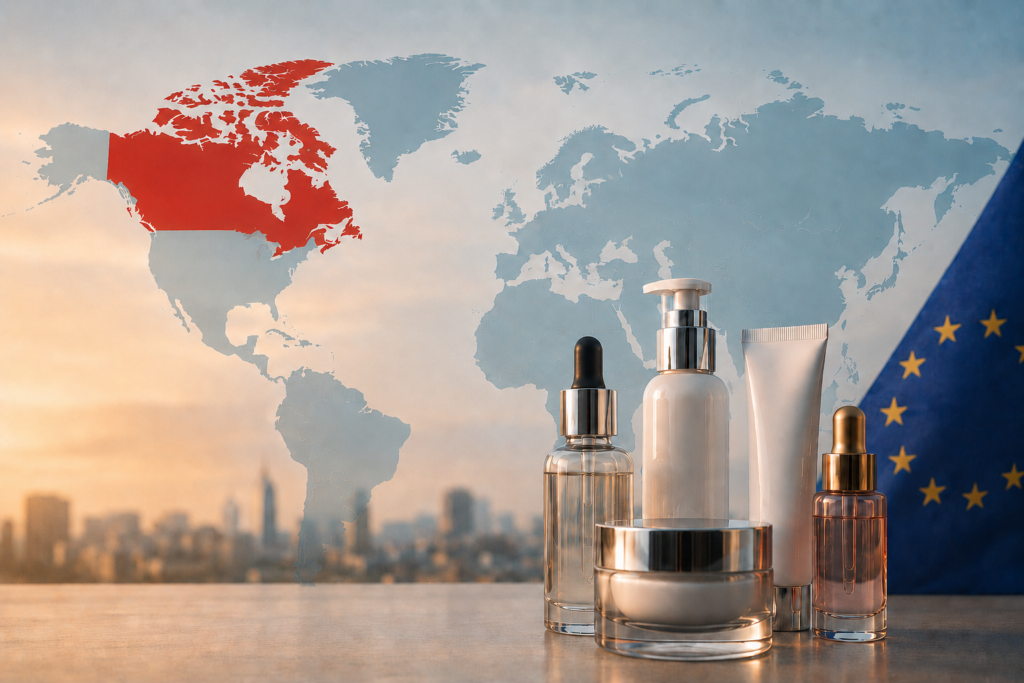
Canadian cosmetics are governed by both the Food and Drugs Act and the Cosmetic Regulations, which aim to ensure consumer safety.
Driven by Health Canada, the regulatory framework has gradually strengthened, particularly following amendment SOR/2024-63, placing greater emphasis on ingredient transparency, optimization of the notification procedure, and enhanced product safety and oversight.
CLEAR takes a closer look at the most recent developments.
Update to the Cosmetic Notification Form
Since 2024, the cosmetic notification system has been strengthened to improve the quality and traceability of product information submitted to Health Canada. This notification (CNF – Cosmetic Notification Form) must be submitted within 10 days following the product’s first placement on the Canadian market.
Several changes have been introduced:
- Appointment of a Responsible Person
Brands must appoint a Responsible Person in Canada (local contact or address). Acting as a key local representative, this contact locally represents the non-Canadian manufacturer and contractually defines their responsibilities.
- Product Classification
A distinction must now be made between rinse-off cosmetic products and leave-on cosmetic products.
- Ingredient Identification
The composition of cosmetic products must be declared with greater precision, using INCI nomenclature or, where not applicable, an appropriate chemical designation.
- Amendment to the Concentration Range Table
Each ingredient must be declared either with its exact concentration or according to a concentration range. The number of concentration ranges has been expanded from 7 to 13, to improve the accuracy of information relating to product composition.
New Allergen Labelling Requirements : A Structural Change
Since 12 April 2026, the initial 24 fragrance allergens must be indicated on product labels when their concentration exceeds 0.01% in rinse-off products and 0.001% in leave-on products.
As of 1 August 2026, the number of allergens subject to declaration will increase from 24 to 81 for new products. Products already placed on the market will benefit from a transition period until 1 August 2028 to achieve compliance.
These new requirements are intended to align Canadian regulations with European legislation.
They require companies to review fragranced formulas to determine whether they are affected by the new allergen labelling requirements and, where applicable, to update INCI ingredient lists and cosmetic notification forms.
Changes to Labelling Requirements for Small Containers
For products whose container or outer packaging dimensions do not allow all required regulatory information to be displayed, the ingredient list may now be made available online.
In such cases, the packaging must clearly inform consumers that the ingredient list is available on a website and specify where it can be consulted.
In addition, the Cosmetic Ingredient Hotlist, established by Health Canada and identifying prohibited and restricted substances in cosmetic products, is regularly updated in line with scientific developments and concerns associated with certain substances.
Lastly, Canadian authorities are paying particular attention to substances of concern, notably PFAS (per- and polyfluoroalkyl substances), whose potential effects on human health and the environment could lead to future restrictions applicable to cosmetic products.
All these developments highlight the need to anticipate regulatory changes and maintain ongoing regulatory monitoring to ensure compliance of cosmetic products intended for the Canadian market.
For any further information or support with placing your products on the Canadian market, CLEAR remains at your disposal.
Links:
- Food and Drugs Act
- Cosmetic Regulations
- Cosmetic Notification Form
- Proposed updates to the Cosmetic Ingredient Hotlist: Prohibited and restricted ingredients – Canada.ca
- La Gazette du Canada, Partie 2, volume 158, numéro 9 : Règlement modifiant certains règlements visant la divulgation des ingrédients des cosmétiques
- Rapport sur l’état des substances perfluoroalkyliques et polyfluoroalkyliques (SPFA) – Canada.ca